Mexico- Chichen Itza and Uxmal
With coastlines along the Gulf of Mexico, the Caribbean, and the Pacific Ocean, Mexico is a unique blend of coastlines, mountains, deserts, and more. It is the 7th major traveler destination, and features some of the most unique beach resorts on the face of the planet.
Morocco - Marrakech
Home of the best cuisines, as well as phenomenal mint tea, it's a country that reverberates with Arabian themes despite being a north African country.
Arizona - Grand Canyon
One of the natural wonders of the world is a staggering 277 miles long. At its deepest, it is about a mile from the rim to the Colorado River below and it is as much as 18 miles wide in some spots.
Showing posts with label Asia. Show all posts
Monday, July 4, 2011
South Korea - Seoul
1:09 AM
Jennifer
The city of Kimchi (fermented cabbage) and Soju (cheap, toxic potato liquor), Seoul is manically fast-paced, yet home to some of the most tranquil temples and palaces you’ll ever see. It’s modern, yet sprinkled with sites that date back thousands of years; conservative, yet home to an every-night-of-the-week party culture.
Seodaemun Prison
Was designed by a Japanese Architect and was constructed in 1908. The Japanese ran this prison to oppress Korean patriots who fought against the Japanese invasion for sovereign independence. Seodaemun Prison is the symbolic site of Korean independence movement and a symbol Japanese cruelty. More than 40.000 independence fighters were imprisoned and tortured here, and died for the country.
63 Building
if you will visit during the week days it'll be nice and quite. you can find there not only great views but also art gallery, aquarium, wax museum and imax, you can buy ticket for one or all the attractions they are all similar price and all worth seeing. i would avoid this place on weekends and holidays, it gets very crowded.
Ice Museum
This is a tiny museum tucked away in Insadong (seoul) near Anguk station. You can walk around the freezer and see different ice sculptures and an entire house made from ice, complete with a toilet and bathtub!! They have mini ice models of the Eiffel tower, Leaning tower of Pisa and a Korean gate.
Namsangol Hanok Village
Five traditional Hanok homes were moved from throughout Seoul to this destination. Furniture and mannequins in the traditional dress are shown in the different houses and represent the status of the tenants. You can get your picture taken in traditional clothing (3,000 won), activities for kids (such as fan painting) and on the weekends they host a variety of performances. Neat to see, especially since it's free.
Sunday, June 19, 2011
China - Beijing
1:57 AM
Jennifer
China’s capital Beijing is full of the kind of iconic images it’s impossible not to hunt down. There’s the portrait of Mao staring down upon his mausoleum on Tiananmen Square, expanses of the Forbidden City, plates of roasted duck in the traditional pagoda restaurants and cups of green tea.
GREAT WALL
Construction of the Great Wall began in the 7th Century BC when China was controlled by feudal warlords. It was joined together (along with China) in the Qin Dynasty (221-206 BC). Rebuilt until the 16th Century, the Great Wall's purpose was to protect the northern borders of the Chinese Empire from invaders. Many legends and myths exist regarding the building of this wall. One of the most famous is The Legend of Meng Jiangnü about love and devotion.
CHAOYANG THEATER
The Flying Acrobat Show at the Chaoyang Theater is an incredible feat of artistry and talent. Tickets range in price depending on where you want to sit and how many are in your group but can range from as low as 80 Yuan per ticket (a bad seat with more than 10 purchased) to over 800 Yuan (for a single seat in the best sections).
TEMPLE OF HEAVEN
Four kilometers south of Tiananmen Square, the largest park in Beijing, covering 675 acres. The buildings found here were built at the same time as the Imperial Palace, and they are noted for their exquisite architecture and harmonious placement within the park among rows of cypress trees, some of which are said to be 800 years old. The temple was designed to mark the meeting point between heaven and earth.
SUMMER PALACE 45 minutes outside of Beijing is where the Emperors and Empresses used to go to escape Beijing's oppressive summertime heat. Located at a higher elevation than Beijing and rebuilt after it was destroyed by European troops in 1860, it features many lovely temples, wooded hills, courtyards, gardens and imperial residences with red columns and wood panels painted with landscapes.
Monday, January 24, 2011
Cook Islands
1:08 AM
Jennifer
The Cook Islands seem to inhabit half the South Pacific. They're so spread out that the casual visitor is unlikely to visit more than a couple of the fifteen, but when you've made your pick, you'll find they all offer their own brand of tropical paradise. Little-influenced cultures and the kind of outlook that makes you wish you weren't born into modernity.
Most visitors land on Rarotonga, which is neatly sandwiched between near impenetrable jungle and typically picture-postcard turquoise seas. Dance all night in haze of tribal culture, explore the rain-forests or take a glimpse into the deep blue from the deck of a glass-bottomed boat, spine tingling as oversized fish flick against the glass.
In Aitutaki you’ll be greeted by an underwater garden full of unfeasibly hefty clams and rainbow fish, all tucked under the surface of a colorful lagoon commended as one of the South Pacific’s most brilliant sites. On shore there are enough beaches to share that you might just find your own, and exploring the backstreets reveals coral-walled churches and ancient tribal meeting spots.
Atiu’s set of deep underground caves and soggy swamps draw in the nature lovers, while the spooky burial grounds give visitors a sinister taste of Polynesian culture and the potent coffee grown at the local plantations makes a perfect Sunday morning hangover cure.
If you have plenty of time, the black pearl fields of far off Penrhyn and Manihiki are a serious trek to get to, but rewarding in their 'far from civilization' isolation, while for culture addicts, Mitiaro offers the best in well-preserved villages and traditional lifestyle.
The Cook Islands are the kind of location where time passes all too quickly, and it’s easy to find yourself stepping back on the plane with the taste of your last Mojito still lingering at the back of your throat, and this south pacific paradise already a fading memory. It’s invariably divine, but try not to get tied to just one beach.
Tuesday, January 18, 2011
Russia - Museums in Saint Petersburg
3:41 AM
Jennifer
St. Petersburg has no skyscrapers and a relatively low skyline. Current regulations forbid construction of high buildings in the city centre. The 310m tall St. Petersburg TV Tower is the tallest structure in the city, while 122.5 m Peter and Paul Cathedral is the highest building.
Russian Museum - devoted to the Russian fine art specifically. Established 1895 by Nicholas II to commemorate his father, Alexander III. Original collection was composed of artworks taken from Hermitage, Alexander Palace and Imperial Academy of Arts. After Russian Revolution, many private collections were nationalized and relocated to the Russian Museum. Main building of the museum is Mikhailovsky Palace.
Cathedral of St Peter and Paul - first stone church in St. Petersburg, built between 1712 and 1733. Its golden spire reaches a height of 404 ft and features at its top an angel holding a cross. This angel is one of the most important symbols of St. Petersburg. Turned into a museum in 1924 it houses the remains of almost all the Russian Emperors and Empresses from Peter the Greatto Nicholas II and his family to Catherine the Great, Empress of Russia for 34 years. Only Peter II and Ivan VI are not buried here.
Kunstkamera - first museum in Russia. Established by Peter the Greatcompleted in 1727. Museum was dedicated to preserving "natural and human curiosities and rarities". Tsar's collection, features human and animal fetuseswith anatomical deficiencies, which Peter had seen in 1697 visiting Frederick Ruysch and Levinus Vincent. The underlying idea was to acquire full knowledge of the world.
Russian Museum of Ethnography -houses a collection of about 500,000 items relating to the ethnography, or cultural anthropology, of peoples of the former Russian Empire and the Soviet Union. In the 1830s, the Kunstkamera collections were dispersed to newly established imperial museums, the most important being the Peter the Great Museum of Anthropology and Ethnography, established in 1879.
Central Naval Museum -one of the oldest Russian museums and one of the world's largest naval museums. The museum's history officially started in 1709 with the foundation of Model-kammer by Peter the Great for the conservation of ship drafts and models.
Zoological Museum - Zoological Institute of the Russian Academy of Science, located on Universitetskaya Embankment. It's one of the ten largest nature history museums in the world. Peter the Great's Kunstkamera collections included zoological specimens. In 1724 the museum became a part of the Russian Academy of Sciences.
Varshavsky Rail Terminal - former passenger train station in St. Petersburg, now serving as the Museum of Railway Machinery. The station was originally built in 1851 for a rail line, completed in 1858, from the city to the Tsar's residence in Gatchina. The line was extended in 1859 to Pskov and in 1862 to Warsaw, which at that time was a part of Russian Empire. A branch from the main line that ran to the Prussian border at Virbalis (now Lithuania) connected Saint Petersburg to other capitals of Europe.
St. Petersburg Museum of History- headquarters of the museum are located in the Peter and Paul Fortress. It was established in 1938 as the Museum of History and Development of Leningrad.
Artillery Museum - Since 1869 its collections, founded by Peter I of Russia in 1703 and consisting of Russian and foreign military equipment, uniform and decorations, are hosted in the Kronverk (a crownwork) of the Peter and Paul Fortress on the right bank of the Neva near Alexander Park.
Saturday, January 15, 2011
Russia Saint Petersburg - State Hermitage Museum
10:55 AM
Jennifer
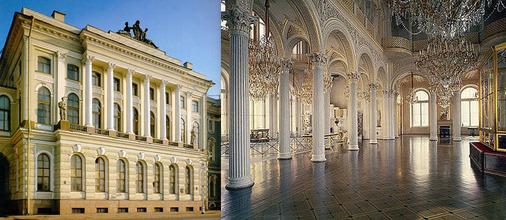
Founded in 1764 when Empress Catherine the Great purchased a collection of Flemish and Dutch paintings from Berlin. Museum's storerooms, exhibitions and departments are in 10 buildings, 7 of them are monuments of 18th and 19th century. Architectural ensemble consists of Winter Palace, former state residence of Russian emperors, buildings of Small, Old (Great) and New Hermitages, Hermitage Theatre and Auxiliary House. Museum includes Menshikov Palace, Eastern Wing of General Staff building, Staraya Derevnya Restoration, Storage Centre and Museum of the Imperial Porcelain Factory.
Winter Palace - biggest building in complex, commissioned by daughter of Peter the Great, Empress Elizabeth Petrovna, in 1754 as official royal residence. Palace was official residence of Russian monarchs till February 1917. Egyptian collection is on the ground floor in eastern part of Palace as well as collection of culture of Ancient Mesopotamia, including Assyrian reliefs from Babylon. On the ground floor in western wing are collections of prehistoric artifacts, the culture of Caucasus and the second treasure gallery.
Small Hermitage -Southern Pavilion combine late baroque with early classicism. Northern Pavilion was constructed on the bank of the Neva in early classicism style. Two structures are joined at the level of the first floor by the Hanging Garden. This architectural ensemble was called "Small Hermitage," because in Northern Pavilion Catherine II had parties with games which were known as "small hermitages." Two galleries at western side of the Small Hermitage from the Northern to Southern Pavilion house an exhibition of Western European decorative and applied art of the 12th to 15th century.
Great Hermitage - was built in 1771-87 to the order of Catherine II and was intended to house the palace art collections and library. Works of Italian Renaissance artists, including Giorgione, Titian, Veronese, as well as Benois Madonna and Madonna Litta attributed to Leonardo da Vinci or his school, are on the rooms on the first floor of the Old Hermitage
New Hermitage -was the first building in Russia specially constructed to house the art collections of the Museum. Italian Renaissance exposition continues in the eastern wing. Gallery known as the Raphael Loggias runs along the eastern facade. In the enfilade of smaller rooms alongside the skylight rooms Italian and Spanish fine art of the 15th-17th centuries, including Michelangelo's Crouching Boy and paintings by El Greco. The Knights' Hall, room in the eastern part hosts a collection of Western European arms and armour of the 15th-17th centuries, part of Arsenal collection.
Menshikov Palace - situated on the University Embankment of Vasilyevsky Island, was built to the order of the first governor of St Petersburg and close associate of Peter I, Alexander Menshikov. Construction of this first monumental stone structure in the city began in 1710. The architectural decoration of the palace is characteristic of the early 18th century. The palace was the most luxurious building in St Petersburg of Peter's time and was often used for official diplomatic receptions and assemblies.
General Staff building - designed by Carlo Rossi, architect of the Russian Classicism style. It was built in 1820-30 and reveals an architectural strictness that was characteristically Classical. Building occupies a vast space from Nevsky Prospekt to the bend of the Moika River. Main accent in the composition of the facade looking on to Palace Square is placed on the magnificent arch - the symbol of the triumph of Russia.
Wednesday, December 22, 2010
Villas on Bali - south and central Bali
2:32 PM
Jennifer
South Bali: Batubelig to Tanah LotRural area well away from the tourist crowds, rice fields and off-white surf beach with strong waves and currents. Quiet and beautiful surroundings but only 15 to 25 minutes away from Seminyak and Legian. Price for renting villas starts from US$1.100 per night for villas per 10 gests up to US$1.650.
Central Bali – Ubud/Gianyar area
Located at the foot of the mountains with slightly lower temperatures than in the lowlands, year-round showers, and lush tropical vegetation. The town of Ubud offers today numerous art galleries, shops and many good restaurants (Mozaic, Lamak, Ary's etc) plus daily traditional dance performances, frequent temple festivals and many cultural events. A good base to explore all parts of Bali. Price for renting villas is US$420 per night for villa per 6 gests.
Monday, December 20, 2010
Villas on Bali - south Bali
11:08 AM
Jennifer
South Bali – Nusa Dua Peninsula
This includes Nusa Dua and adjacent Tanjung Benoa with many international hotels, good beaches and water sports facilities. This area also includes the "Bukit", the hill south of Jimbaran beach which offers spectacular views and usually enjoys sunny days even when it's raining in other parts of Bali. Both areas are close to one of the island's best golf courses and give easy access to many shops and restaurants. Not much night life in these areas. Price for renting any this villas starts from US$280 per night on villas per 2 guests (popular with honeymooners) to US$ 360 per night on villas per 4 guests or US$ 420 – 840 on villas per 6 guests. Butler service and air – conditioned car with driver are included in this price.


Subscribe to rss feeds